The first sign of change wasn’t loud. It came in the form of a small plate of baked goods left quietly on a doorstep. Two neighbors who had avoided each other for a year after a dispute reconciled thanks to a movement called “50 Days of Love.” With gestures as simple as leaving a plate, a knock at the door and a note, the silence between them ended.
“It all begins with one step, one smile, one cookie,” says Ric Olsen, Executive Director of the community organization Love Orange.
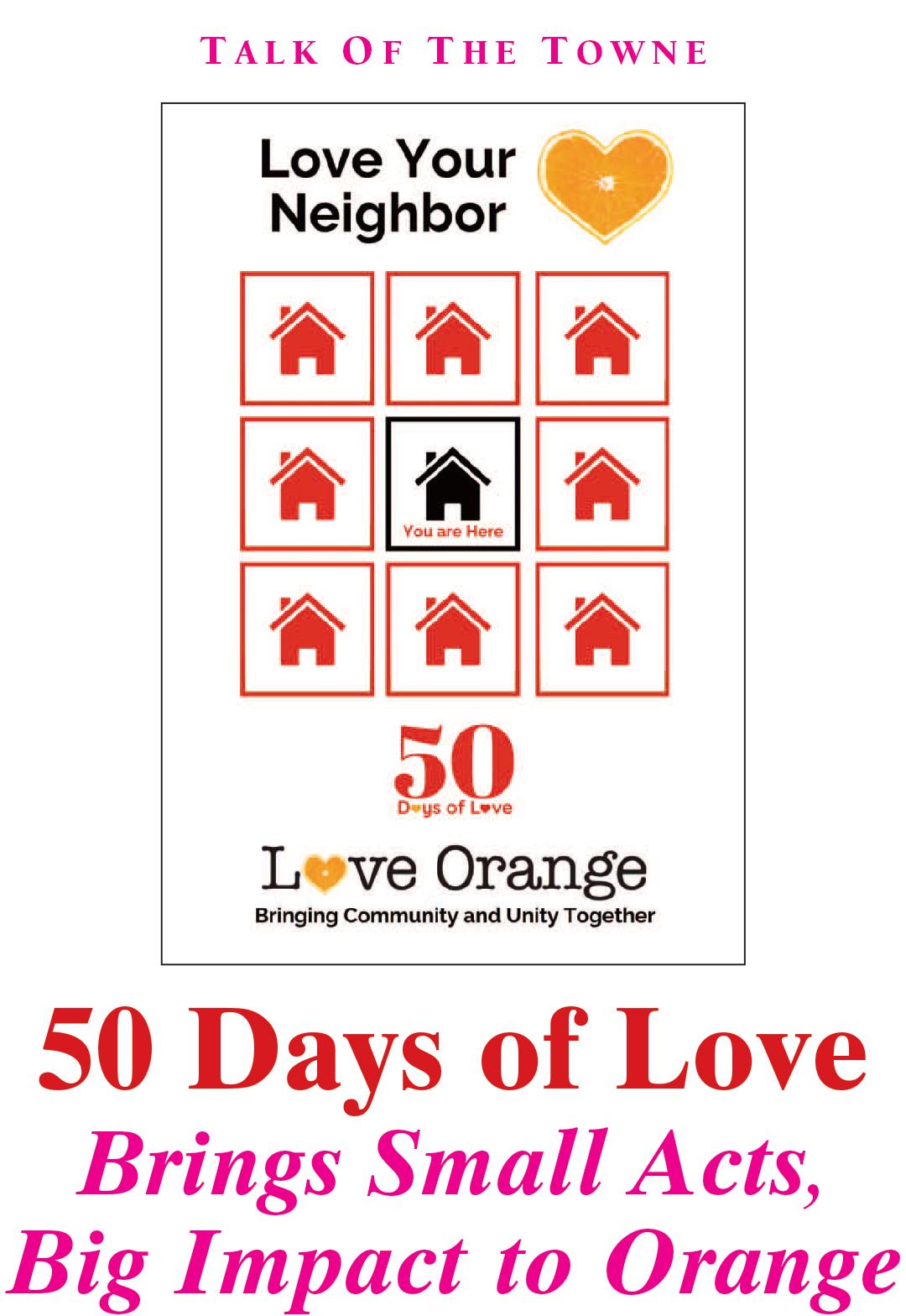
The growing community initiative “50 Days of Love,” taking place April 5 through May 24, challenges people to reconnect with the eight households closest to them. Created as part of the broader “Hopeful Neighborhood Project,” the campaign asks the question, do you actually know the people who live next door?
“The goal of 50 Days of Love is to get people to know their actual neighbors,” Olsen says. “Do you know their names? Have their contact info? Are you comfortable reaching out to them in an emergency?”
The idea emerged because while neighborhoods are physically close, people have become socially distant, Olsen says. When someone sees a stranger lingering, or a stray dog, they don’t always know who to call or how to help. When you know your neighbors, those questions arise less frequently.
During the pandemic, Olsen recalls, residents put up Christmas lights in July, wrote hopeful chalk messages on sidewalks and offered to run errands for people who couldn’t leave their homes. Those small acts became the foundation of a larger vision.
Today, 50 Days of Love is being used as a catalyst to form neighborhood councils and connect residents with city emergency management and first responders. The goal is not just friendliness, but resilience, especially for vulnerable populations like seniors.
Jaime Gomez, Love Orange Director of Operations, has seen how those small steps can ripple outward. For the past several years, local congregations have written encouragement cards to first responders, city leaders, medical professionals and school staff.
“The congregations involved love writing the cards and feel like they’re making an impact,” says Gomez. “It’s a simple and easy way to connect with people right where they live.”
Children from the Youth Centers of Orange have written letters of encouragement to residents and thank you notes to nonprofit organizations as part of 50 Days of Love, says Cameron Geringer-Pate with the Hub OC. “(The children) learn that thanking each other is a great path toward relationship building, and developing yourself as a community member is important,” he says.
The initiative has also introduced yard signs—visible markers that signal participation. Once residents learn the names of their surrounding neighbors, they receive a sign and are entered into a prize drawing.
“With the yard signs, more and more people are reaching out to ask how they can acquire one,” Gomez says.
Still, organizers emphasize that success isn’t measured in numbers, at least not yet. The initiative is new, and its growth is intentionally slow, built relationship by relationship.
“If one person gets excited about the people they live next to, then that is success,” Olsen says. “If we get neighbors to start working together, that is huge success.”
There are early signs of that success already. Beyond reconciled relationships, new connections are forming in numerous ways. A group of women who barely knew each other have started a sewing class together.
“50 Days of Love is less an event than it is a lifestyle,” says Olsen, who notes that research supports what organizers are seeing firsthand. People who know their neighbors tend to be healthier, happier and more resilient.
But for Olsen and Gomez, the motivation is as much about hope as it is about data. “We have hope in what can be accomplished,” says Olsen.
To acquire a yard sign and learn more, contact 50 Days of Love at info@LoveOrange.org