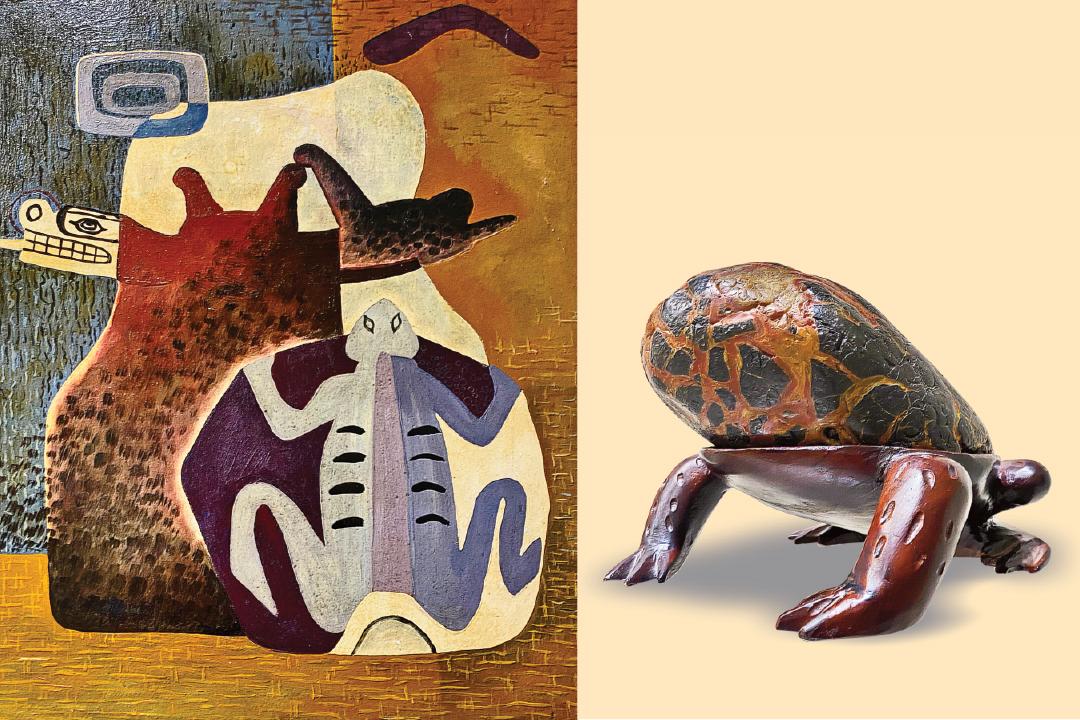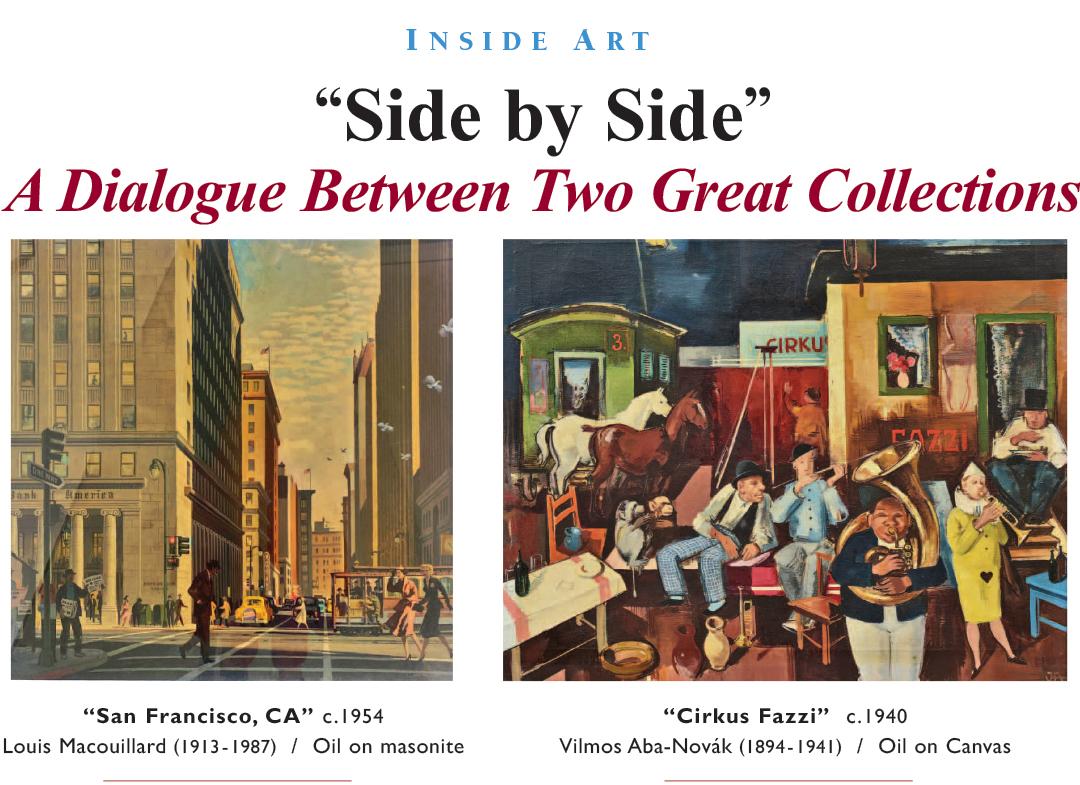
At the Hilbert Museum of California Art in Orange, two remarkable art collections come together in a unique visual conversation. “Side by Side: Paintings from the Bank of America Collection and the Hilbert Collection” (on view through January 25, 2026) pairs masterworks by leading California artists—literally side by side—to reveal new insights into their creative journeys. The exhibition celebrates the 100th anniversary of Bank of America in Orange County.
Curated by Mary Platt, Director of the Hilbert Museum, the exhibition draws upon the outstanding corporate art collection of Bank of America, one of the world’s largest, with some 60,000 works spanning painting, photography, sculpture and prints. The bank’s holdings include postwar American art by Ed Ruscha, Joan Mitchell, Frank Stella, and California masters such as Millard Sheets and Louis Macouillard. Through its active loan program, Bank of America makes these works accessible to museums worldwide, underscoring its commitment to preserving and sharing the arts.
“The idea behind ‘Side by Side,’” Platt explains, “was to celebrate BofA’s 100 years in Orange County by creating a direct visual dialogue. By pairing works by the same artist from both collections, visitors can see how an artist’s style evolves over time and how different collectors interpret their work.”
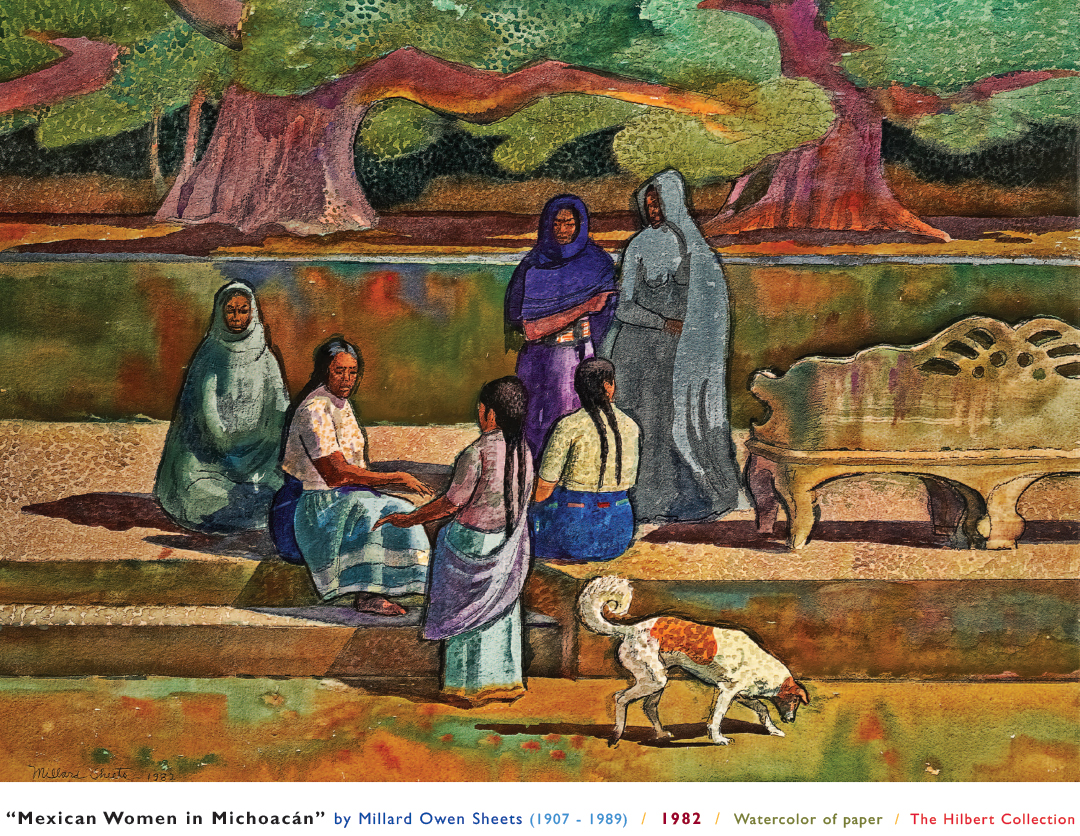
Among the most striking pairings is that of Millard Sheets, a central figure in California Scene painting, who is represented by two distinct works. “Fish Rock Island” (1979, Bank of America) captures the drama of the Mendocino coast, while “Mexican Women of Michoacán” (1982, Hilbert Collection; seen on this issue’s inside front cover) conveys quiet dignity and cultural richness. Seen together, they reveal Sheets’s deep empathy for both land and people, united by his glowing palette and compositional precision.
The Hungarian modernist Vilmos Aba-Novák brought circus life vividly to canvas. His tempera “Circus Family Life” (Bank of America) and oil painting “Cirkus Fazzi” (Hilbert Collection) reveal two sides of the same world: the intimacy of performers backstage and the exuberance of their public persona. Though far from California geographically, Aba-Novák’s dynamic forms and earthy humor appealed to West Coast collectors drawn to European modernism.
Dennis Hare’s evolution from expressive figuration to quiet abstraction appears in “Man in Cap” (1987, Bank of America) and “The Strand” (2015, Hilbert Collection). Both works explore solitude and reflection, and his hallmark themes of human vulnerability and connection.
Modernist pioneer Stanton Macdonald-Wright, co-founder of the Synchromist movement, bridges abstraction and spirituality in “Kannon” (1961, Hilbert Collection) and “La Voce Degli Angeli” (1969, Bank of America). The first channels Buddhist serenity through flowing forms and saturated color, while the second translates that harmony into ethereal watercolor. Together they reveal his synthesis of Eastern philosophy and modern color theory: painting as visual music.
Paul Wonner’s paired still lifes—“Dutch Still Life with Half Grapefruit and Blue-and-White Napkin” (1979, Bank of America) and “Fruit and Kitchen Towels on a Big Table” (2001, Hilbert Collection)—trace his path from classical Old Master precision to relaxed contemporary subjects. His command of light and texture unites both.
San Francisco artist Louis Macouillard captured the pulse of city life with a designer’s eye. “Market Street, San Francisco” (1946, Bank of America) brims with postwar vitality, while “Keep to Right, San Francisco” (1930s, Hilbert Collection) offers a softer, watercolor glimpse of hillside calm.
Macouillard’s dual career as fine artist and illustrator connects naturally to “Side by Side’s” display of mid-century Bank of America advertising art—vivid works created by Macouillard, Millard Sheets and Amado Gonzalez. These original 1950s ads, on loan from the Bank’s corporate archives, celebrate the postwar California dream—bustling cities, growing industries and everyday life depicted with painterly flair. They remind viewers of a time when fine artists lent their talents to envisioning the Golden State’s optimism and progress.
In appreciation for the exhibition, Bank of America made a generous gift to the Hilbert Museum. Two works from “Side by Side” now join the museum’s permanent collection. Robert Frame’s “The Bridge” (c. 1971–72) turns an architectural structure—likely near Santa Barbara—into a lyrical abstraction of line and light. Amado Gonzalez’s “Calexico – Border to Border” (c. 1957), originally created for a Bank of America advertisement, reflects the vibrant colors and human warmth characteristic of mid-century California art.
Museum founder Mark Hilbert expressed his gratitude for these works, saying, “These gifts honor the museum’s partnership with the bank in commemorating Bank of America’s 100th anniversary in Orange County, and underscore our shared commitment to celebrating California’s cultural heritage.
Platt agrees, noting, “This exhibition celebrates not only the artists, but the connections that art creates—between institutions, communities and generations. When these works are seen side by side, you don’t just see the paintings—you see the continuing story of California creativity.”
- - - -
The Hilbert Museum of California Art at Chapman University is located at 167 North Atchison St. in Old Towne, across from the train station. The museum is open Tue-Sat 10 am to 5 pm, and admission is free. To save time checking in, pre-register online at www.HilbertMuseum.org. More information: 714-516-5880 during open hours.